Pages

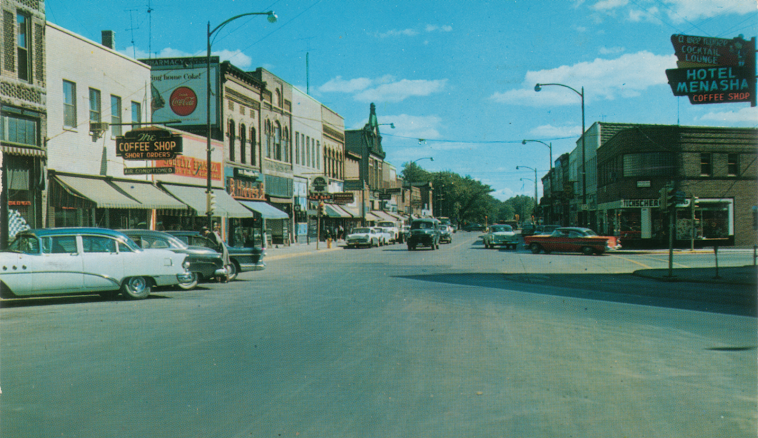
Downtown 1958

Downtown 1958

Thursday, October 31, 2013

Broad Street Changes - 1962


February 18, 1962 Appleton Post-Crescent
 
We have seen recent blog entries highlight the construction of a new Germania Hall in 1963, the historic grocery of John Schriebeis from the 1880's and the building of the Riverside Clinic in 1957, all on Broad Street.  Here is yet another entry about Broad Street. 
 
This article showcases efforts to transform Broad Street into a business and commercial zone, one of the many efforts over the years to stimulate business in the downtown area.  As with the article, research supports the idea that at one time in the 1800's, the intersection of Appleton and Broad Streets was the nucleus of what could have become a third commercial district, after Main Street and the Tayco Street Bridge area, perhaps even becoming the dominant area.  The two taverns and former grocery remaining at that intersection bear witness to that effort.  And, to add even more emphasis to this contention, remember that the US Government Land Office had been relocated from Green Bay in the 1850s to a location on Broad Street to regulate the sale of public land bought from the Indians. 

Today, the remnants of this 1962 effort to bolster Broad Street seem to be the absent homes that once bordered the rear of Main Street businesses, sacrificed for parking. 

Wednesday, October 30, 2013

Riverside Clinic


The clinic building to the left opened in late 1957 as Medical Associates with office space for ten doctors.  Later it became known as Riverside Clinic.   The building on the right was completed in 1968 as an addition to the clinic and had office space for nine more physicians.  In 1974, the McClone Insurance Agency took over the original building when Riverside Clinic and Twin City Clinic in Neenah merged to form the Nicolet Clinic.  This was the forerunner of today's Affinity Medical Group.  

Tuesday, October 29, 2013

Ah...!


Appleton Post-Crescent, April 1953
 
 
Wisconsin Rapids Tribune March 13, 1953
 
Featured today, a couple of Gem Beer ads from 1953.  The brewery in Menasha would last another three years, closing in 1956, while other Walter Brothers breweries in the state, and one in Colorado, would continue into the '70s and beyond. 

Monday, October 28, 2013

1911 Encyclopedia Britannica Entry

Menasha

MENASHA (an Indian word meaning "thorn" or "island"), a city of Winnebago County, Wisconsin, U.S.A., 88 m. N. of Milwaukee, and 14 m. N. of Oshkosh, attractively situated at the N. extremity of Lake Winnebago at its outlet into the Fox River. Pop. (1890), 4581; (1900), 5589 (1535 foreign-born); (1905, state census), 5960; (1910), 6061. Menasha is served by the Minneapolis, St Paul & Sault Ste Marie, the Chicago, Milwaukee & St Paul, and the Chicago & North Western Railways, and by an inter-urban electric railway system. Several bridges across the Fox River connect Menasha with Neenah, with which it really forms one community industrially. Doty Island, at the mouth of the river and divided about equally between the cities, is a picturesque and popular summer resort.

Menasha had good water power and among its manufactures are paper and sulphite pulp, lumber, wooden-ware and cooperage products, woollen and knit goods, leather, boats and bricks. The first white man to visit the site of Menasha was probably Jean Nicolet, who seems to have come in the winter of 1634-1635 and to have found here villages of Fox and Winnebago Indians. Subsequently there were French and English trading posts here. The city was settled permanently in 1848, and was chartered in 1874.
------------------------------------------------------------------------------------------------------------------------------------------------------------------------------
I find the statement interesting, about how "... the bridges connect Menasha with Neenah, with which it really forms one community industrially."   That statement is (was) true in more ways than just industrially, though many citizens of both towns would argue against it.  Also, I find the Doty Island reference curious, as if it was simply a vacation spot.  Yes, Roberts' Resort was a big attraction on the island, but much of the island by 1911 was already residential and had industrial sections and was a part of both cities.   

Friday, October 25, 2013

Interurban Rates

Interurban rates for 1918


From about 1898 to 1927, when the electric trolleys were abandoned in favor of buses, you could travel around the Fox Valley for pocket change.  At a time when mailing a letter cost 3 cents, a nickel trolley ride in 1918 was affordable.  That nickel is worth about $1.20 in today's money.  There was even an extended inter-urban railway that travelled between Neenah and Oshkosh (see map below), though I expect the rates were higher, of course. 


Thursday, October 24, 2013

Schreibeis Groceries


Pictured above is John Schreibeis and his grocery wagon.  Mr. Schreibeis, a long time resident of Menasha, was first introduced via the book, Menasha, where he was shown as a city policeman in 1890. Born in Two Rivers in 1861, he arrived in Menasha in 1881. He served as a police officer for four years before leaving the force and entering the grocery business at 546 Broad Street. He also became instrumental in local politics, serving as Fourth Ward member of the Board of Education, city postmaster, and was a member of the Board of Parks Commissioners.

Wednesday, October 23, 2013

Chilly Waters Near Water Street


The railroad bridge on a chilly day near Water Street, ca. 1985.  You can see the power plant at the extreme right of the photo.