Pages

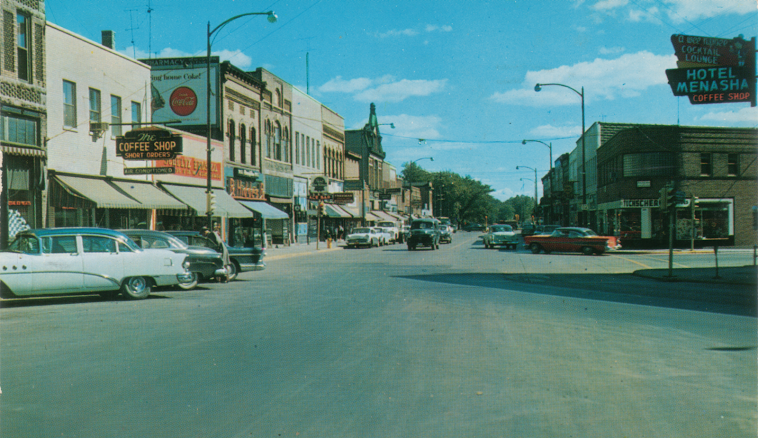
Downtown 1958

Downtown 1958

Wednesday, October 3, 2012

Leo Neugebauer


Born in Austria in 1852, Leopold Neugebauer settled in Menasha, WI in 1870, operating a slaughter house south of Main Street near the Tayco Street Bridge and a meat market on Appleton Street north of Broad.  His residence was at 64 Water Street.  He was a councilman with the city of Menasha and a member of the Menasha Masonic Lodge.  After his death in 1896, a Mr. F.A. Zheim opened his own meat market in Neugebauer's facility on Tayco Street and ran it for several years. 

This illustration comes from a 40-page 1887 book published by the city to entice businesses to come to Menasha entitled, The Booming City of Menasha, Wisconsin, U.S.A.: Its Trade, Industries, Inducements to Capitalists, and Pre-Eminence as a Manufacturing, Residence, and Educational City.  In blog posts to come, we will again refer to this reference, as it is proving to be a treasure-trove of information about the Menasha that was generating excitement in the Fox Valley in the late 19th century.  It appears to be quite the public relations tool for the city for its day.

Tuesday, October 2, 2012

Bowlby's Sweet Shop


September 7, 1967

Bowlby, for a time, was successful enough to have a store in Appleton, too, on College Avenue near Sears if I correctly recall.  Not sure which came first...as if that was important to a kid who just liked his candy. 

Monday, October 1, 2012

Main Street Scene


as seen in Ghosts in Sunlight: A Remembrance of Things Past by Suzanne Hart O'Regan (1985)

This street view of Main Street looking east was photographed between 1886 (when the streetcar line was established between Menasha and Neenah) and 1898 (when the streetcars were electrified).  As the carriage approaches the Bank of Menasha on the left, in the distance, you can see the R.M. Scott building at the corner of Main and Milwaukee and Beck's Meat Market.  Next to that would have been Sam Roby's "Old Settler" store, dealing in groceries and other essentials.

Friday, September 28, 2012

Red Bird at High Cliff State Park


June, 1961 articles from the Post-Crescent
 
Although Red Bird was a great chief of the Winnebagoes, most accounts indicate that he was never in our corner of Wisconsin, having lived and fought in the Prairie du Chien area on the other side of the state and he was imprisoned in Minnesota.  Still, he was memorialized in statue form at High Cliff in 1961 as a symbol for the conservation movement and a source of pride to the Winnebago people. 

High Cliff State Park is the only state-owned recreational area on Lake Winnebago. The park gets its name from the limestone cliff of the Niagara Escarpment, which parallels the eastern shore of Lake Winnebago. Red Bird Trail is the longest trail within the park.

Thursday, September 27, 2012

Getting the Brin Ready

 
This October 31, 1928 article from the Northwestern details the preparations getting the Brin ready for its opening in December of that year.   I'd like to have seen it in its original glory. 

Wednesday, September 26, 2012

Speak Closely Into the Transmitter....


From the 1913 Neenah-Menasha telephone directory

Even as a boy in the '60s, I recall Ma Bell still publishing public service-type ads in the phone book, reminding us how to dial the phone properly by allowing the dial to fully finish rotating before dialing the next number, speaking clearly, looking up the correct number first to avoid misdialing, etc. 

Remember when we had 5 digit phone numbers and that letter prefix?  My phone number was PArkway 2-6579 and we had a party line.  Explain that to your kids today. 

Let's all take the "telephone pledge" now....

Tuesday, September 25, 2012

Paved Roads and Wooden Sidewalks

As seen in this 1898 photograph, looking east on Nicolet Boulevard from the top of Walter Brothers Brewing, the old wooden sidewalks are quite evident, a period detail that gives 19th century Menasha a particular charm, though I'm sure the reality was quite different.  I hear people say, oh, isn't it charming, what with the horses and all?  Yet they neglect the practicality of ridding the streets of the obvious waste problem.  And then there's the smell.  Other details of the time would be dirt roads, hitching posts, and gas lights, though electrification was well underway by this time.  1898 saw the streetcars electrified that year.  It's a fact that Main Street wasn't paved in a modern manner until 1910, so I wouldn't be surprised that wooden sidewalks were still found in some parts of the city until the 1920s. 


The map below was published in a 1903 treatise published by the state of Wisconsin regarding paving of roads within the state.  The map shows that essentially, paving in Menasha, for the time, extended from the Neenah border, down Washington Street to Main and then down Racine to Third and on to Old Plank Road where it ended.  And this applied just to the roads, so one can imagine the sidewalks and other lesser travelled streets as an afterthought.