Pages

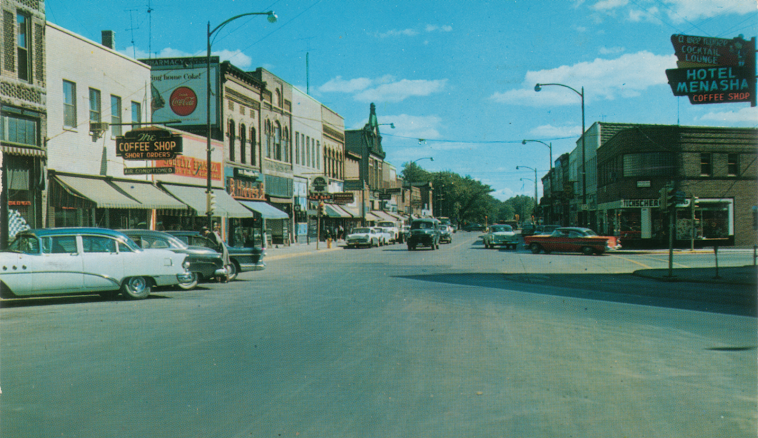
Downtown 1958

Downtown 1958

Wednesday, November 7, 2012

What IS Cable TV?

December 3, 1973 NM Daily Northwestern

I remember when cable TV came to town.  My family never subscribed while I lived there, but my best friend did and I marveled at his being able to watch "exotic" TV channels from Milwaukee and Madison, and best of all, WGN in Chicago! 

This ad doesn't reflect it, but a year or so later when HBO was offered, his folks added that to their subscription and I can remember watching commercial-free movies and comedy specials at his house with George Carlin and Robert Klein, complete with all the "mature themes" and bad words.  Gotta love that "keep on truckin'"-esque illustration, but then, it WAS the 70's! 

Hard to imagine a time when you'd need to have a Q&A ad to explain something that we so take for granted now.  And for someone's cable bill to be only $5.50 per month?  Wow! 

Tuesday, November 6, 2012

The Mystic


May 21, 1887 Oshkosh Northwestern


Before railroads became the dominant means of conveyance, Menasha, with its presence by water utilized steamboats of all varieties to move cargo and passengers.  In the late 19th and early 20th century, paddlewheel steamboats were in service along Lake Winnebago and the Fox River, similar to ones seen on the Mississippi for example, though on a lesser scale.  Smaller pleasurecraft like the Mystic pictured above were a more affordable and convenient means to take a day long excursion to the other side of Lake Winnebago or to travel down to Oshkosh or Fond du Lac for picnicking.  Docking facilities might be nonexistent to the point of being precarious as seen in the above photo, but that didn't stop determined passengers from boarding.   

Monday, November 5, 2012

The Ol' Swimmin' Hole


Before the Menasha swimming pool, there was this...This 1897 photo shows the swimming area near the present day Memorial Building. In the background, you can see a swimming tank sheltered against the elements and the public's gaze, for modesty sake.  It'd be 60 years before the pool was built.  (photo courtesy of Steamboats on the Fox River by D.C. Mitchell, 1986)

Friday, November 2, 2012

"When You Live in Menasha, You Vacation Your Life"


Frank Hoffmann's grocery was at 163 Main Street, just a few doors down from the First National Bank.  We first caught a glimpse of it in the July 4th photo I posted on the blog earlier this year.  Obviously, Frank was a promoter of the city, as evidenced by the stationery he was using touting the advantages of living in 1930-ish Menasha.  I can only presume this was an intitiative of City Hall/Chamber of Commerce and expect that other merchants were doing the same thing.  Interesting slogan. 

Thursday, November 1, 2012

Alexander N. Strange

from Memories of Doty Island (1999):

   Alexander Strange was born in Menasha in 1856. His education was in local elementary and high schools. He married Jane Chapman, a very talented and colorful person and daughter of Mr. John Chapman, formerly of Chapman & Hewitt Woolen mills. She loved people and entertained lavishly. She wrote the lyrics for a song used in 1912 for the Menasha Homecoming celebration. Eddie Hanson, the organist at the Doty Theater in Neenah, wrote the music.
   For a time Alexander moved to Watertown, Wisconsin, where his father-in-law operated a woolen mill. Alexander managed the plant until 1895 when he returned to Menasha and managed the John Strange Paper Mills which his brother owned. This did not work out well, so he and others established the Island Paper Company which bought Howard's company. They stayed in business until the 1920's, making corrugated paper which aggravated the citizens because of the odor which it emitted. They called it "strawboard."
   Alexander built the home at 515 Keyes Street in Menasha. They had only one child, a son, Alexander Thomas, who carried on the ownership and control of the Island Paper Company when he grew up. When he married, he and his wife moved in with his parents. They continued to live there even after their two children, Jane Clair and Alexander N., were born.


 Alexander N. Strange home at 515 Keyes Street


Mr. and Mrs. Strange in front of their home in their chauffeur-driven 1911 Oldsmobile

Wednesday, October 31, 2012

Free Thermometer


December 3, 1973 NM Northwestern

Who among us remembers when banks, along with other merchants, used to give away items such as this?  Of course, it was all a veiled attempt at advertising- calendars, pencils, snow scrapers and the like festooned with the company's (or bank's) name and logo and phone number and address. 

As a young boy, I liked going with my Dad to the Banta Credit Union and I usually came home with a pencil or a coin purse or maybe a pocket calendar, especially when they were headquartered on the second floor of the Mill Street side of the Hotel Menasha.  I don't recall it being quite so grand when they moved their offices out to Warsaw Street in 1972.  Maybe it was because I was older and a free pencil didn't mean as much.  (That 5% return on an account today would far outweigh that free thermometer!) 


Tuesday, October 30, 2012

Direct Dialing


April 5, 1962 Oshkosh Northwestern

1962 brought direct distance dialing to Menasha and the advent of...area codes.

Initial use of area codes in the United States and Canada began in 1947 with large cities.   Area codes were assigned based on the length of time a rotary dial phone took to dial the area code. Densely populated areas like New York City, Chicago, Los Angeles, and Detroit had huge incoming call volume and were assigned numbers (212, 312, 213, 313) that could be quickly dialed from a rotary dial phone. On a rotary dial phone low digits (1, 2, 3, 4) could dial quickly as the time the rotary dial took to return to the home position was minimal. High digit numbers (7, 8, 9, 0) on rotary dial phones took much longer to return to the home position and were usually used in less densely populated areas like rural Texas (915). This numbering strategy became unnecessary when touch-tone phones arrived, as the tone allowed instant entry of digits.  Based on the above logic, with Milwaukee being the state's largest city, it made sense that it would be in the 414 area code while the more rural northern counties would be relegated to 715.  Why Menasha and the rest of the Fox Valley was included in 414 was either because it was reflective of the growing population base from Fond du Lac to Green Bay or perhaps a convenience due to geography. 

Of course, Menasha now finds itself in the 920 area code, created in 1997, and starting in 2014, I read that area code 274 has been proposed to join in the 920 area over much of eastern Wisconsin.  Implementation was planned to begin in 2012, but conservation efforts and less need for numbers because of the economic crisis caused the date to be pushed back to 2014.  Beginning then, all new telephone numbers will have the 274 area code, while old ones will keep their 920 area code. 

That phone pictured below is definitely from a more simpler time.