Pages

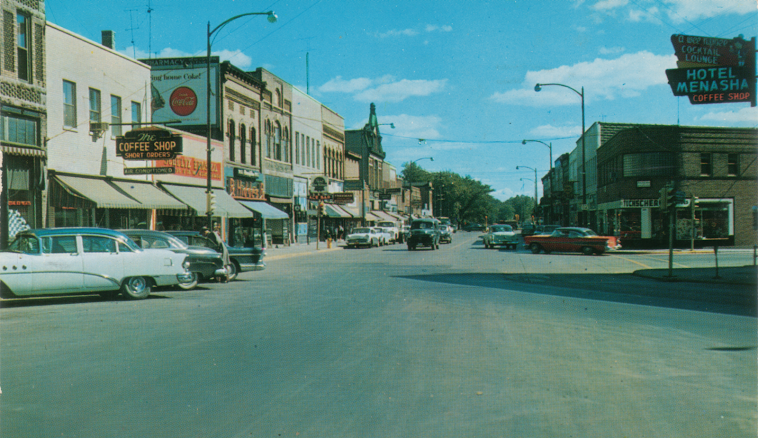
Downtown 1958

Downtown 1958

Wednesday, April 30, 2014

Flower Beds


Yet another early 20th century lovely postcard view of the flower beds in Smith Park.  Over the years, it's beautiful flower gardens have provided the background for countless wedding, graduation, and prom photos.  Needless to say, it's a photographer's dream.

Tuesday, April 29, 2014

Orville J. Hall

   
Orville J. Hall, a pioneer citizen of Menasha, was born in Vermont, March 14, 1818, son of Abner M. and Eunice Hall, the former born in Cornwall, Vermont, and the latter in Litchfield, Connecticut, both of English descent. When he was less than a year old his parents moved to St. Lawrence County, NY, where he grew up on a farm. He received a common school education, and at the age of seventeen he started out into the world.  After a year of farm work in Niagara County, NY, he came west as far as Indiana, and during one summer he helped to construct a dam across the Wabash River, near Delphi. He then returned to his home in New York, and for about seven years was connected with a stage company. In 1845, he learned daguerreotyping and for about four years, he pursued this art in New York, Ohio, Indiana, Illinois. Michigan, Wisconsin and Canada.
 
He was married September 20, 1849, to Delilah Pauline Danforth. She was born in Fort Covington, Franklin County, NY, April 25, 1829, the daughter of David and Pauline Richmond Danforth, both natives of Danville, Vermont, the former of English and the latter of Scotch descent. Immediately after their marriage Mr. and Mrs. Hall came to Wisconsin, and during the winter which followed made their home in Plover in Portage County. In the spring of 1850, they settled in Menasha, where they lived out their lives. Menasha at that time was a mere hamlet, so they have been identified with Menasha throughout its entire history. He managed a grocery store for a short time and then turned his attention to the brewery business in partnership with A. K. Sperry. During the years 1860 and 1871, he and Frederick Loescher, who was then his partner, erected the Menasha brewery on Manitowoc Street, and his connection with it continued until the fall of 1872.  Later, it became the WInz Brewery. From November, 1872, to July, 1873, he was the partner of Samuel Roby in a general store. 

Concurrent with his business pursuits, Hall became active in politics.  In 1860, he served as chairman of the town board of supervisors in Menasha, and this made him a member of the county board. He served another term as a member of the county board of supervisors in 1873. That same year, he became village president in Menasha's last year before incorporation as a city.  In 1874, he was elected as the first mayor of the city of Menasha, and served one term, successfully bridging Menasha's governmental transformation.
 
Hall died on January 28, 1890 and his funeral was held in his home pictured below. His widow remained in the home until her death in June of 1916. Thereafter, the house was owned and occupied by their daughter and her husband, Mr. Harrison DeWolf, the cashier at the Bank of Menasha.

The Orville Hall house at 410 1st Street was originally built in 1870.


references:
Randall, Geo. A. / Illustrated Atlas of Winnebago County,
Historical & Architectural Resources Survey, City of Menasha, Winnebago County, August 31, 2009

Monday, April 28, 2014

Hypatia Boyd Reed


Hypatia Boyd was the daughter of George and Jean Boyd, immigrants from Scotland. Born in Milwaukee in 1874, she had scarlet fever at the age of six, and as a result, lost her hearing. She attended the Day School for the Deaf in Milwaukee and learned speech reading rather than sign language.
 
Both Hypatia and her husband were much involved in service to the deaf. Hypatia went on to regular high school and graduated. She then was accepted into the University of Wisconsin (the first deaf person to go to a college). She taught for a time at the School for the Deaf in Delavan, Wisconsin where she met Charles Reed, who later was the postmaster for Menasha. Charles was Curtis Reed's son and was born deaf and only did sign language. She married Reed on October 7, 1903. They lost a son, Charles Boyd Reed as an infant child in 1906, and they had one daughter, Lydia Jean Reed. Mr. Reed passed away in 1911 when their daughter was only two years old. But she continued her cause-writing many articles for the local newspaper, and the Milwaukee Sentinel, as well as the Silent Worker Magazine in keeping with her advocacy for deaf issues.

Friday, April 25, 2014

Soldiers' Monument


January 23, 1919 Grand Rapids Tribune
 
Let it never be said that the hearts of the city fathers weren't in the right place.  I always find it fascinating to muse on "what might have been."  But as so often happens, reality sets in and local tensions get compounded, especially when dealing with the rival town next door.  Was it the $30,000 cost, or some perceived infraction about the location...who knows? 

I never saw another mention of this idea again.  And judging from the way this headline was written, I suspect the writer of this piece wasn't surprised either. 

Thursday, April 24, 2014

Two Years Ago Today


Two years ago today I began this blog by posting this postcard photo.  My intention at the time was to just drum up some attention for a simple picture book I was having published to benefit the Menasha Historical Society.  But it soon became apparent that this blog was something more than a vehicle for publicity.  Yes, it served its purpose, but even after the initial interest for the book had faded, you came back again and again. 

Considering that I administer this all from my home in South Carolina, it can be challenging at times.  But because of the internet and email and Facebook, I am able to do this. I truly believe that in no other era could I be as successful at this as I am today. 

Many of you have told me how much you gain from this blog, but in reality, I am the true winner. Your comments, emails, and Facebook posts have helped to fuel my imagination and contribute ideas while I add to this blog each week.  Thank you for your continued support, enthusiasm, and friendship.

Wednesday, April 23, 2014

City Hall


This postcard of the old city hall/fire station predates the expansion of city government and the necessity for more office space.  By 1917, the old city hall had become cramped and the city purchased the old First National Bank building.  This was not the stately columned ediface, but rather the original bank to the west.  The next year, the police department moved out of city hall to a property just west of the Menasha City hall.  After these moves, the old city hall was used by the Fire Department and the Common Council until 1963.  In that year, the First National Bank building constructed in 1917 (the columned one) was purchased by the city and merged with the older building next door, as the bank was building its new facility across Main Street from the Bank of Menasha.  Combined, the two buildings now housed city offices and the council chambers.  The old city hall remained in use by the Fire Department until the 1970s and eventually was demolished in the 1980s. 

Tuesday, April 22, 2014

US Tractor Company

February 26, 1919 Oshkosh Norhtwestern
 
 
Farm Implement News, December 25, 1919
 
Back in January, we discussed automobile manufacturing, something that happened only for a very short time in Menasha.  It came on the heels of the demise of the US Tractor Company in 1922-23.  Today, we read how the firm came to town, via Chicago, settling first at the old Woolen Mills offices on Tayco Street and later making its home on Sixth.  The ad above, is from that very first year the company moved to town.