Pages

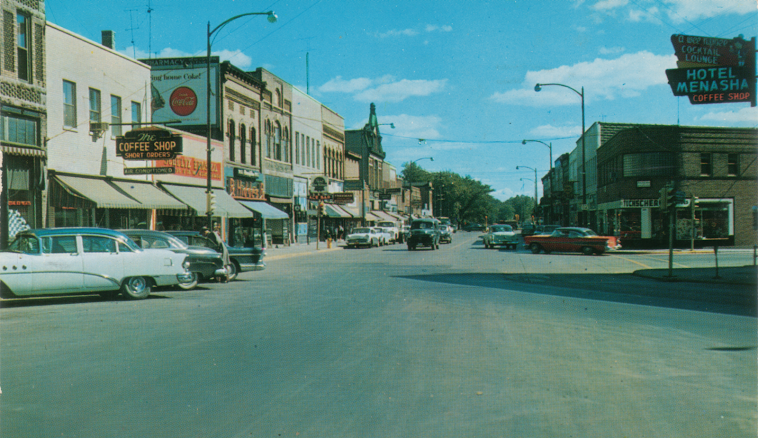
Downtown 1958

Downtown 1958

Friday, July 20, 2012

Menasha Pool


July 26, 1957 Oshkosh Daily Northwestern

Expect Large Crowd to See Menasha Pool

MENASHA - A large opening day crowd is expected to pass through the doors of Menasha’s new $400,000 swimming pool, Sunday at 2 p.m.

The filling of the pool with water began at 9 a.m. Thursday and was completed by noon today. 

The main pool, bathhouse, water treatment building and all electrical and plumbing work has been completed.  Cleaning and painting in the small wading pool remains.  The public will be asked to cooperate by staying out of the incompleted sections.  Rope barriers will be erected prior to the Sunday opening.

Capacity of the Menasha pool, when the two smaller pools are put into use, will be 1,300.  Hourly checks will be made to keep the number of swimmers in safe limits.

One of the features of the pool, the bleacher deck on top of the bathhouse, is also expected to be busy Sunday.  Open free of charge, this area can accommodate 700. 

Thursday, July 19, 2012

St. Thomas Episcopal Church


The original portion of St. Thomas Episcopal Church was completed in January 1916, approximately four months after the articles of incorporation were filed and the name of the church chosen. This original portion of the church was estimated to cost $12,000 and prior to its completion, services were held in the Menasha public library. An existing residence north of the new church was utilized as a combined rectory and parish hall and a gym/meeting hall addition was made in 1921.

By 1955, attendance rendered it necessary to tear down the parish house and build a new, larger facility. On 28 February 1961, fire seriously damaged the west (altar end) of the nave of the church and services were temporarily held in the Neenah theater building. Following damage assessment, it was determined that a new church, or a significant addition, was needed to fulfill the needs of the congregation. After reviewing a number of design options, Harry Weese & Associates of Chicago was chosen as the architect and groundbreaking for the new church occurred on 12 August 1962. Witnessing the erection of the 120-foot spire (which was fabricated in Fond du Lac) was cited as a major community event.  Since its inception in 1915, the church served both Neenah and Menasha Episcopalians.  Following construction of the new $370,000 facility (dedicated in June 1963), it truly serves both communities just by virtue of its location, as the main entrance is located in the City of Neenah, while the nave is in the City of Menasha.

Wednesday, July 18, 2012

Last of the Pail Makers


Taken in 1956, this photo shows the last group of workers that made pails for the Menasha Wooden Ware, just before the factory closed its doors, ending a tradition that had begun in 1849.  Menasha had once been known as the "Pail-making Capital of the World." 

The Twin City News-Record commented that this "was the same pail that Grandma got when she went to the old general store and asked the clerk to include butter in her provisions for the month.  And it's that old pail, always looking the same, that Dad got when he bought nails to repair the house or barn.,  And it's the pail the kids saw under the Christmas tree, but which they were too busy to notice because they were occupied with removing the candy from it.  And yes, it's that pail that once held such diverse items as pigs' feet or shredded tobacco, jelly or pickles; maple syrup, or medication for horses' hooves...."

Standing from left, Stanley Sperger, Frank Schmidt, Mike Mayefski, Ben Dombrofski, Emmanuel LeComte, and Walter Stommel.  Seated: Bob LeComte, Dick Fox, Stanley Novakofski, Gene Verkuilen, and Dick Buss. 

Tuesday, July 17, 2012

Germania Opera House (Germania Hall)


Germania Hall on 320 Chute Street was home to the Germania Benevolent Society in Menasha. The society had its beginnings on December 1, 1856 when nine men started the Concordia Society, with the purpose of helping the sick and burying the departed.  In 1862 a rival German organization was founded, the Menasha Turner Society.  In 1888 the two societies combined under the name of German Unterstuetzungs Verein. In 1927 the name was changed to the Germania Benevolent Society. In the late 19th and early 20th century, the facility had a life as an entertainment venue, calling itself an opera house for a time.  The clipping above is from the March 8, 1902 edition of the New York Dramatic Mirror, a show business style newspaper of the time.  This building on Chute Street was built in the 1860s and razed in 1963.

Monday, July 16, 2012

Steamboats


Early on, the rivers were the logical and most convenient means for moving people and goods across country.  However, many places along the river contained a drop where a rapids prevented boats from continuing on.  The boats had to be unloaded, with the cargo and boats portaged, or carried over land past the rapids, and then re-launched.  This proved to be a major inconvenience, costly in time and money.  The Fox River drops a total of 170 feet between Lake Winnebago and Green Bay, but with the development of the locks system in the 1850s and 60s, this made movement along the Fox River much easier and led to a golden age of steamboat travel.

“The Fox”(pictured) was built in 1892 and operated through 1900. This vessel is representative of the type of steamboat traveling up and down the Fox River and Lake Winnebago.


Friday, July 13, 2012

Some Facts About Menasha (1898)


From the June,1898 Souvenir Edition of the Menasha Press:

At the present writing Menasha has:
Two large department stores
Four large general stores
Two shoe stores
Two clothing and furnishings stores       
Sixteen grocery stores                     
Six meat markets                               
Two banks                                  
Three hardware stores                     
Two drug stores                           
Four hotels                                 
Four restaurants                         
Twenty-three saloons                        
Three flour and feed stores                
Three new depots
Three coal and wood yards
One gun store
Three jewelers
Five bakeries
Two furniture stores
Two millinery stores
One variety store
Three tailoring establishments
Five barber shops

The mayor and aldermen serve without salary.
The assessed valuation of Menasha is about $1,200,000.
Menasha has about three miles of electric street railway within its limits.   

Menasha is the second city of Winnebago county in point of population.
Property is assessed at less than 33 1/3 per cent of its value on an average.
The Wisconsin Telephone company has about 100 subscribers in the city.
The city is lighted at night by seventy-five arc lamps, costing about $5,000 per year.
The tax levy in Menasha has never been above 3.5 per cent. This year it was under that figure.
Menasha's healthfulness may be judged from the fact that with a population of 7,000 it supports only four doctors.
The first white child born in Menasha was Lydia Hunt, born in 1848. She is now Mrs. George Wells and lives at Stedman, Ga.
Menasha has two daily papers The Evening Press and The Evening Breeze; and three weeklies: The Press, The Breeze and The Anzeiger (German)
The police force of the city consists of four-a chief and three patrolmen, besides several special policemen who serve at depots and factories without pay.


The total bonded indebtedness of the city at present is about $60,000--all representing money expended for needed public improvements, such as schools and bridges.

Although containing a population of 7,000, the city limits embrace only four sections of land. If Menasha should appropriate as much outlying territory as many towns of 2,000 and 3,000 have its population would not fall much short of 10,000. There are few cities in Wisconsin whose principal residence streets are so beautifully wooded and shaded as those of Menasha.  "Forest City" would be a proper name for the place to adopt were it not already appropriated by a half dozen Wisconsin cities whose shade trees do not compare with those of Menasha.


Thursday, July 12, 2012

Smith Park


In the 1890's, Menasha Wooden Ware founder Elisha D. Smith tried to attract Downer College, then located at Fox Lake, to move to Menasha. He was disappointed when the authorities decided to merge with Milwaukee Women's College and move to Milwaukee. Smith decided that the rejected 40 acres he had offered Downer should be offered instead to the City of Menasha to become a park. This donation was made in 1896 at about the same time as his offer to build the city a library. Ironically, many years later, Downer College merged with Lawrence University in Appleton.

The heavily wooded property was located between “The Avenue” (Nicolet Boulevard) and Cleveland, Keyes, and Park Streets.  Along with the land, Mr. Smith had a pavilion constructed to encourage use of the park. A pious man, he stipulated that there be a strict ban on alcohol, circuses, gambling, sports, and dangerous machinery at the park. Of course, this ban also included Sundays, except for religious activities and temperance meetings.  The designer of Chicago's Lincoln Park, Olaf Benson, was chosen to design the gardens and walks within the new park and when completed, it was the pride of Menasha. 
Over time, Menasha residents seem to hold dearest the many memories of the dances that were held over the years. 
To illustrate that, here’s an excerpt from 1999’s Memories of Doty Island : A Link Between Two Cities, edited by Caryl Chandler Herziger and Winifred Anderson Pawlowski:
In the 1930's an area teenager could go to three dances a week-Wednesday, Friday, and Sunday-from 7:00 to 11:00 P.M. at the Memorial Building. Boys and girls came from Appleton, Oshkosh, Omro, Winneconne (sometimes even from Green Bay) besides Menasha and Neenah. Occasionally, on a Friday night, there would be a school dance after a basketball or football game, but otherwise it was, "See you at the Mem!"
Everyone came early, paid the required nickel, went upstairs and had his or her hand stamped. By 7:30 the popular girls (the best dancers) already had every dance for the rest of the evening promised to someone. How they kept track of when each partner was to appear for his dance, no one knows, but it seemed to work out. Imagine remembering who you had the 16th dance with!!  Music was by records (with someone unknown running the machine) piped from downstairs. The Mem had a great dance floor, and the balcony doors were unlocked so anyone could go out there for a romantic moment or two. Or they could go down the steps and wander across a bridge onto the dark and secluded island. There was also a soda fountain on the first floor so thirst could be quenched, but no drinks were allowed upstairs.
About 10:30 some of the regular partners began to leave. It took a little while to get home-not via the shortest route, of course. The parents knew the dance was over at 11:00, so they allowed a reasonable time to get home after that. However, if a little ride or walk was in the minds of the young people, there would be extra time.
During the summer there was a park dance in the park pavilion every Monday. The dance floor was anything but smooth, but there was real live music! And very good music, too- not just some amateur, pick-up band. Tom Temple and Tony Winters were the next best thing to Tommy Dorsey or Glenn Miller.
Even if you weren't asked to dance, you could sit on a bench outside the pavilion and listen and talk with jealousy about the lucky ones who were "tripping the light fantastic." Maybe a non-dancing male would ask you to go for a walk into the darkness! Whatever you did that night was fun and gave the participants something to discuss until the next Monday.