Pages

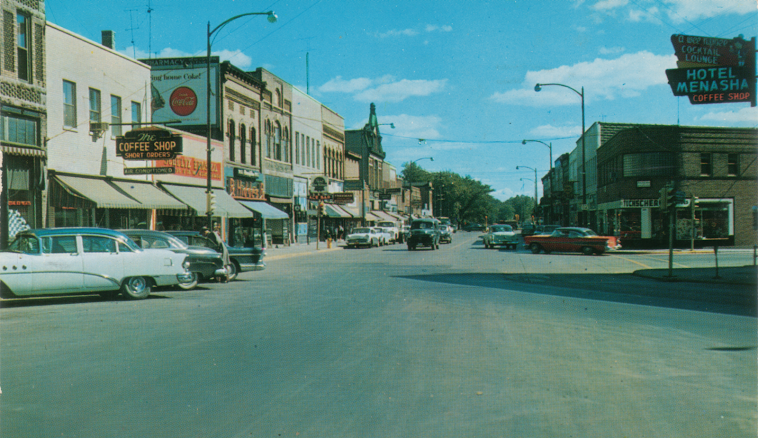
Downtown 1958

Downtown 1958

Wednesday, July 11, 2012

Menasha Hub and Spoke Factory

From: History of Winnebago County, Wisconsin, and Early History of the Northwest by Richard J. Harney (1880)


The Menasha hub, spoke, bending and general wagon and carriage stock factory of Webster and Lawson, was established in 1856, by A. J. Webster, the senior member of the firm, in a small way.

The original factory was a small building located on the dam, on the present site of the Coral Mills. Early in May of that year the high water carried away a portion of the dam, and also a part of the canal bank, leaving the embryo spoke factory cut off from the mainland, and without power to do anything; thus necessitating a removal to some other locality. There being no available building in Menasha, it was decided to remove to Neenah. The contents of the factory were, therefore, loaded on a small scow and towed to Neenah, where it remained but one year, doing a small and unsatisfactory business.   At the expiration of one year the machinery was moved from Neenah back to Menasha, into the Bowman Building, where it remained one year, when another break in the canal caused a suspension for the season. It was then moved into the large Williams building, in the fall of 1858.  Here it remained until the year 1861, when Mr. P. V. Lawson, who had been engaged in the manufacture of sash, doors and blinds, for some time, selling out his business, entered into a partnership with Mr. Webster, under the firm name of Webster and Lawson. During that year, the firm built, on the site now occupied by. their extensive works, a small factory, which was found to be inadequate to the wants of their increasing business, when additions were made to the buildings, and steam power added. 

The business continued to grow and extend, requiring enlarged manufacturing facilities. More land was, therefore, purchased, buildings erected, and new machinery put in the same.  The works have since then been enlarged, from time to time, until they now occupy some ten acres of ground, with extensive shipping-docks, storerooms, and railroad side-tracks.  This mammoth factory now employs throughout the year one hundred and seventy-five men, and manufactures 2,500,000 spokes, 120,000 hubs, 520,000 sawed felloes, 15,000 sets of bent felloes, and large quantities of shafts, poles, bows, sleigh and cutter material, and hard and soft wood lumber, aggregating a value of $175,000.  ("Felloes" is an Old English word that means the rim or a section of the rim of a wheel supported by spokes.)  The manufactures of the firm are widely known, being shipped over a wide extent of country, from New York to Oregon.   The material used is oak, hickory, ash, elm and maple, of which 6,ooo,ooo feet are required per annum to supply their works.  Their network of railroad side-tracks and shipping docks give every facility for shipment, both by land and water, and the business of the concern is conducted on the most systematic principles, by thoroughgoing and energetic business men.

Tuesday, July 10, 2012

Metropolitan Sample Rooms

From the June,1898 Menasha Press (Souvenir Edition):

The fine block shown in the accompanying cut is occupied by G.E. Heup’s Metropolitan Sample Rooms.  It was built in the early part of the ‘80’s by the late A. Belanger, who conducted a grocery store and saloon therein for several years.  On October 9, 1883, Mr. Belanger, who had closed out his grocery stock some time before, sold the saloon business to Mr. G.E. Heup, who for some years previously had been in charge of a sewing machine agency.  Mr. Heup adopted the name of Metropolitan Sample Rooms for his new place of business, and as such it is known to this day.  The Metropolitan is one of the finest establishments of its kind in the county.  Its bar fixtures are of the most expensive and attractive make; the rooms are finished in hardwood, and the furniture and decorations are in keeping with the general high character of the place.  Mr. Heup intends to still further improve it in the near future, and make it without a rival in the twin cities,  An unusually large stock of bulk liquors is carried- all of the highest grades and especially adapted for medicinal purposes.
Mr.  Heup’s sewing machine agency has grown with the passing years.  He handles the White, Davis, New Home, and other favorite brands and during the past eighteen years, has sole over 1,000 machines of various makes in this vicinity.  He is one of the most experienced and successful agents in these parts, and his dealings with the public have always been mutually satisfactory and pleasant. 
Mr. Heup was born in Milwaukee County in 1856 and located in Menasha twenty-six years ago.  He has a wife and three children – two sons and one daughter- and lives in the residence portion of the Belanger block, one door west of his place of business.

UPDATE:   There's been some interest as to where this business was located exactly and I should have determined this to begin with.  The Menasha city directory of 1895 says its address was 90 Main Street, between where today's Becher Electric and the old Brin would be. But in 1900, the address was listed as 213 Main Street which equates... to where the Twin City Bar was in 1967, across from the Menasha Hardware. In 1905, Heup's address was 144 Main Street. By 1910, Mr. Heup didn't appear anymore in the directory. Perhaps there was some renumbering of addresses on Main Street or Mr. Heup moved his business a lot. I'm pretty sure the photo equated to the original 90 Main Street address, as the text I quoted from was from an 1898 newspaper.

Monday, July 9, 2012

Resists Moisture!


At one time Marathon, a major manufacturer of pulp, paper, and paperboard, was the largest printer in the world and its extensive operations were spread over five states. The company was in a paper specialty field, which proved to be a wise choice; the business provided a stable demand. David C. Everest, CEO of Marathon for close to 47 years in the mid-twentieth century, and a man of colorful quotes, stated frequently that "people will quit the eatin' habit last."  Thus, bread wrappers, paper food containers, and wax paper were manufactured at plants in Menasha, Wausau and Ashland. 

Friday, July 6, 2012

"...Particularly strong in his opposition to vagrants...."

Daily Northwestern February 15, 1890

Roessler is Dead

Menasha's Marshal Expires

A Well Known Official Succumbs to Pneumonia at the Age of
Thirty-four years- Brief Illness- Biographical sketch.

Menasha, Wis., Feb. 15-  At two o'clock this morning occured the death of Marshall David Roessler.  Several days ago he was taken down with pneumonia, which, from the first, seemed to have a settled hold upon him.  He grew gradually worse until this morning when he passed away.  The flag is at half mast above the city hall and his death is deeply regretted by all who knew him.

David Roessler at death was thirty-four years of age.  He was born in this state and came to Menasha about thirteen years ago.  He was a man of powerful physique and exceptionally pleasant manners.  He had been marshal of Menasha for several years.  He was particularly strong in his opposition to vagrants and many of them speak of him as "the terror."  His duty was always faithfully performed.  He leaves a wife and five children.  He carried an insurance policy with the Modern Woodmen for $1,000, which not long since he wished to discontinue, but was persuaded by his friends to keep it a short time longer.  His funeral will be at one o'clock Monday from the Turner hall.  He will be buried at Oak hill.

Thursday, July 5, 2012

Downtown Looking East

This 1940 photo shows a vibrant downtown Menasha in the spring or summer months.  The two girls riding their bikes in the center of the photo, while passersby converse on the street in front of the corner drug store, evokes a Norman Rockwell feel to a day gone by.  Is the aproned butcher/grocer crossing behind the bikers hurrying back to his shop to meet the Verifine ice cream man?  Or is he on another errand?  With America on the verge of World War II, the innocence of this photo is bittersweet.

Wednesday, July 4, 2012

Happy Independence Day!

Needless to say, a lot has changed since this 1943 parade in downtown Menasha, but despite my living elsewhere, Menasha is, was, and will always be my hometown. 

As Erma Bombeck once said, "You have to love a nation that celebrates its independence every July 4, not with a parade of guns, tanks, and soldiers who file by the White House in a show of strength and muscle, but with family picnics where kids throw Frisbees, the potato salad gets iffy, and the flies die from happiness. You may think you have overeaten, but it is patriotism." 

Here's wishing you an overdose of patriotism today.  Happy 4th of July!

Tuesday, July 3, 2012

Chicago & North Western Railway


Built in 1892 in the Victorian Romanesque style, the Chicago and North Western railway station was strategically located on Doty Island, practically straddling the line between Menasha and Neenah. Notice the taxi, ready to take passengers to hotels in Menasha. The citizenry took pride in having a train depot larger than that of nearby Appleton or Oshkosh.  Passenger service at this depot lasted until the spring of 1971 when AMTRAK took over railroad passenger service and we lost our passenger rail connection to the world.