
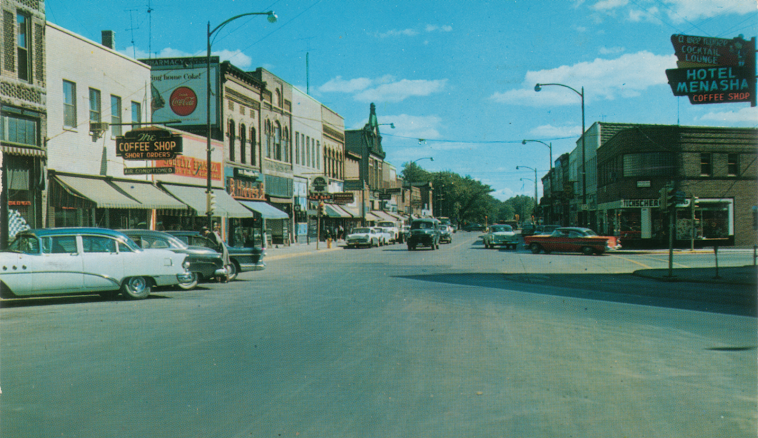
Downtown 1958
Friday, August 31, 2012
Slippery Seal Revisited
Thursday, August 30, 2012
John Marx House

1898

1986
John Marx, president of the John Strange Paper Company, had been a clothing merchant in Menasha since 1872. He was born in Germany, November 25, 1839, son of Nicholas and Anna M. Marx, and after attending school until the age of twelve, he was then apprenticed to the tailor trade. After learning his trade and serving time in the army, he emigrated with his parents to America in 1867, locating at Clifton, in Calumet County, and soon after he located in Menasha. He married in September, 1872, Gertrude M. Baum, daughter of Henry Baum, born in German, and engaged for a time in the clothing trade in Menasha. What led him to such business success beyond tailoring clothes is unclear, but Marx also eventually became president of the Neenah and Menasha Gas and Electric Light Company and sat on the board of directors of the Island Paper Company and the First National Bank of Menasha. He was also an alderman for three terms.
His house at 108 Main Street was constructed in 1882 and was occupied by his family until after the turn of the century. Architecturally, it was of the "High Victorian Italianate" period of construction with some elements of the Queen Anne style also. After this, it became a rental property and by 1931, the house had been converted to the dental and medical offices of Drs. L.D. Costello and George E. Forkin.
The Marx house was located to the west of the old fire station on Main Street and as such, was in the way of the three-story office building to be constructed overlooking the Menasha Marina in the late 1980s. Development of the marina by the City of Menasha required a permit from the Army Corps of Engineers to breach the canal retaining wall. The Corps granted the permit upon completion of the compliance process under Section 106 of the National Historic Preservation Act of 1966, as amended. One requirement of this process was that the city actively offer the Marx house for sale and relocation for a period of six months prior to demolition, with the proviso that the house could be temporarily relocated to permit construction of the office building. The temporary move took place but it is unknown if the house was ever purchased and relocated beyond its temporary location.
Wednesday, August 29, 2012
Gem Beer

Tuesday, August 28, 2012
August 27, 1964


Monday, August 27, 2012
Whiting Paper

The George A. Whiting Paper Company mill was built on the site of an abandoned dry dock located on the west end of the Government Canal in 1882 by George A. Whiting I and the Gilbert Brothers- Theodore and William. The company was known as Gilbert and Whiting until 1886, when Mr. Whiting bought the Gilbert interest. It was equipped with one small 76" trim, Fourdrinier paper machine and other machinery necessary for the manufacture of rag-content paper.
On August 24, 1888, a serious fire ravaged the mill and, when the firemen turned a stream of cold water on a hot steel bleaching drum, a disastrous explosion occurred, killing 16 spectators and firemen. The mill was rebuilt by Mr. Whiting, and the same paper machine, with some improvements, is still in operation. About 1910 the mill discontinued the manufacture of rag-content paper and switched to the making of high grade chemical pulp specialty papers. The business was conducted under the name of "George A. Whiting Paper Mills" from 1886 until April, 1911, when Mr. Frank B. Whiting became associated in the business with his foster father. It was incorporated at that time, and it has been known as the George A. Whiting Paper Co. ever since. George A. Whiting I died in June, 1930, when Mr. Frank B. Whiting succeeded to the presidency. Soon after Mr. Frank Whiting's death in March, 1952, his only son, George A. Whiting II, took over the reins as president.
Today, Whiting Paper Company is owned and operated by 4th generation Frank B. Whiting II and 5th generation siblings George A. Whiting III and Tina Whiting-Pfeffer. The mill now specializes in scrapbooking and fine art papers.
Friday, August 24, 2012
Fizz-Nik Party with Colonel Caboose


But much like Ralphie, who, in the movie, A Christmas Story, learns firsthand the bittersweet truth between advertising and reality with his Little Orphan Annie decoder ring, I had my eyes opened too. As I learned later, the Fizz-Nik had no discernible seal between the two halves of the sphere, so naturally it had a tendency to leak at precisely this critical point. Of course, this didn't become apparent until the initial test flight, so to speak. Always good at following directions, I tipped it back the way the kid does on the package and voila! A foamy eruption of soda and ice cream cascaded down my arm to the elbow. Needless to say, that contraption was soon relegated to the kitchen junk drawer and it sat there for years, being pulled out periodically for another go-round and then, just as quickly washed and dried and put back again as soon as its failures again became apparent. Why it was never just thrown out is beyond me.
Coke had a similar device at the time known as the Astro-Float. Now I never knew about that one until I chanced to peruse eBay one day many, many years later looking for a Fizz-Nik (I wanted to prove to my kids that this thing existed). I could have had one for the Buy It Now price of $9.99...a bit steep from the 1961 price of 49 cents, but hey, price is no object for a real collectible! I ended up not buying it, but still, it brought to mind Albert Einstein's definition of insanity which was doing the same thing over and over again and expecting different results. And who of us as kids, hadn't done some of that?
Thursday, August 23, 2012
Local Grocers

Of special note, is the article about Catholic education at the top of the page. This article reads as if it was first presented as a Sunday sermon, but if only to gain support for what was an effort at the time to create a new centrally located Catholic high school to replace St. Mary's. The effort eventually stalled and we didn't see a new Catholic high until the new St. Mary's came along in 1996. More to follow on that in the coming weeks.
Subscribe to:
Posts (Atom)