This photo dates from May of 1911 and shows Main Street and Loescher's Hardware behind the two. In today's Menasha, these fellows would have been standing near the foot of the Racine Street Bridge. The guy on the right seems justifiably proud of their catch, though the other seems a bit concerned. Perhaps he had just been told that he had to clean them.
A blog which supplements my two books, Menasha, and Neenah and Menasha: Twin Cities of the Fox Valley
Pages
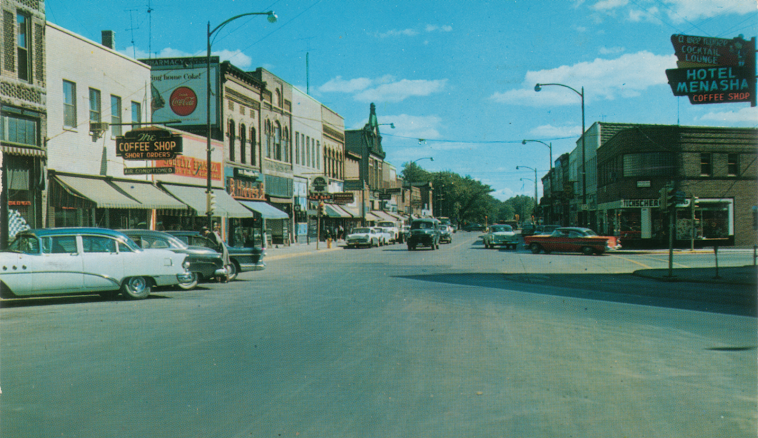
Downtown 1958
Thursday, October 18, 2012
Wednesday, October 17, 2012
Tip-Top Revisited
Tuesday, October 16, 2012
Banjo Joe Gazecki
Joe, at right, about 1916
Located at 408 1/2 Racine Street, the Bungalow Cycle Shop, run by Joe Gazecki, is in the center of this photo, ca.1928. Pictured are some early versions of snowmobiles.
May 13, 1962 feature on Banjo Joe in the Post-Crescent
from a June 13, 1967 Oshkosh Northwestern feature
Banjo Joe Gazecki, musician, racing enthusiast, tinkerer, inventor, retailer, fix-it man, and raconteur was, until his death in 1976, a renaissance man in Menasha. Be it racing bicycles or cars, snowmobiles, or anything with a motor in it, Joe would do it. A lifelong musician, he learned the banjo on his own, practicing three hours a day while making a living repairing bicycles and motorcycles. In time, he became a "trick" banjoist, playing one-handed and even behind his back, garnering him regional and national fame enough to count Red Skelton and Liberace as his friends. In his later years, Banjo Joe made himself a familiar figure at hospitals, rest homes and institutions in the area, entertaining the patients in his free time and traveling at his own expense.
Monday, October 15, 2012
Sailer-Whitmore Foundry
ca. 1912
from P.V. Lawson's 1908 History, Winnebago County, Wisconsin : Its Cities, Towns, Resources, People Volume II:
"The Sailer-Whitmore Machine Company succeeded to the foundry and machine shop, a brick structure located on the spur canal near Tayco Street, formerly owned and equipped by James Little & Sons in 1876 for the manufacture of feed cutters and mowing machines and a general machine shop business. It was in 1891 taken over by the MacKinnon Pulley Company, who added the business of split-iron pulleys. In 1902 the company was succeeded by Sailer & Moxley. When Mr. Moxley retired in 1906 the present incorporated company assumed the management of the shop located at 315 River Street."
This version of the company manufactured machinery for paper mills and wood working.
Friday, October 12, 2012
You Can Be Sure....
As we end another week, let's join this lone walker as he ponders the Westinghouse slogan used in conjunction with the Menasha Electric Utility. Its offices were formerly housed in this, the R. M. Scott building at Main and Milwaukee Streets.
I think of John F. Kennedy's quote, "We would like to live as we once lived, but history will not permit it." Maybe so, but within the confines of this blog, it's nice to try, at least in our memories.
Thursday, October 11, 2012
Newspaper Quotes About Menasha and a Fantastic Prophecy
In 1887, Mayor Lawson commissioned a book to showcase the commercial aspects of Menasha in order to entice business prospects to relocate to our fair city and set up shop here. The book had many wood-cut drawings of factories, businesses, banks, schools, the new City Hall, and the picturesque scenary. I mentioned this book several blog postings ago and today, I bring you selected quotes from the book, among them, one prophesying how Menasha will be 13 years hence in 1900 and a not-so-subtle dig at our neighbor to the south.
The last sentence about "...air boats propelled..." found me scratching my head. But thank goodness for Google! As it turns out, this is a reference to a book, published in 1871, entitled Vril: The Power of the Coming Race by Sir Edward George Bulwer-Lytton. This book was about a journey to an area under the surface of the Earth inhabited by an offshoot of the human race that mastered a sort-of "universal energy" known as Vril,. It was a very powerful influence on spiritually-inclined individuals in the late 19th and early 20th century and was a major precursor to the science-fiction genre. I'm sure the great H.G. Wells was quite familiar with it.
And if that wasn't enough, Bulwer-Lytton was also the inspiration to Charles Schulz for all those Snoopy cartoons with him at the typewriter on top of his doghouse. Sir Edward was responsible for that hackneyed phrase, "It was a dark and stormy night...."
Wednesday, October 10, 2012
Herb's Food Town
April 5, 1962
an ad from 1960
Subscribe to:
Posts (Atom)


